Showing posts with label claire. Show all posts

Sunday, 7 December 2014

Inequality - Civil Rights

The Moment I Realised What It Means To Be A Minority

This is an article from the Huffington Post, posted on the 1st December by an American journalist named Nasir Fleming. In the article Fleming talks about the first moment he realised he was "different".

'I discovered that I was black in the third grade. No -- not really. I have always known that I had brown skin, but I did not start to realise what having brown or black skin represented in a social, economic and legal context until halfway through elementary school.'

He goes on to talk about several defining moments in his childhood where he felt singled out 

'During my younger years, I attended a predominantly white elementary school. In the third grade, after finishing our lesson about the Civil Rights Movement, my teacher stated, "If it weren't for Martin Luther King Jr., Nasir and [other student] would not be in this class with us today." I'm sure that my grade-school teacher did not mean any harm by this comment, but it was definitely shocking -- mainly because I did not recognise any major differences between my classmates and myself'

His feelings of inferiority are soon forgotten however, until the moment he realise that although his teachers told him that times have changed now, its not actually true. Fleming argues that although race is a social construct and does not scientifically exist, the concept of race still institutionally and socially outs people of colour at a disadvantage. Having witnessed certain recent events eg the killings of Emmett Till, Trayvon Martin, Mike Brown and although its not mentioned the more recent unnecessary death of Eric Garner, unjust mass incarceration rates, enormous poverty gaps, de facto segregation of neighbourhoods and schools and lack of colour diversity amongst people in social, political and economic power, Fleming came to the harsh realisation that people of colour are not equal, nor will they ever be.


Fleming believes that the reason why people of colour will never be equal is because today's society is a society that has literally been constructed for white people to excel and succeed and that this is something that everyone should realise and accept, period. This critical view is not positive in fact Fleming ends the article in way that provides little hope for the future.

'I recommend that we just admit that we live in a society where race plays a role in our daily lives. Denying the idea of race will not make it go away. I recommend that all people, no matter what colour, self-reflect and question their understanding of race and how race affects them, whether in a positive or negative way. Once this self-reflection is complete and we recognise the injustices of this system, then we can better plan to make a change. Our "American experience" should not be minimised by the hue of our skin.'
Overall, the article highlights the issue of racial inequality as a relevant issue in modern day America, saying that contrary to popular belief recent events in America prove that there is still tension over civil rights.

Sunday, 30 November 2014

From Wealthy to Nothing


The Great Depression

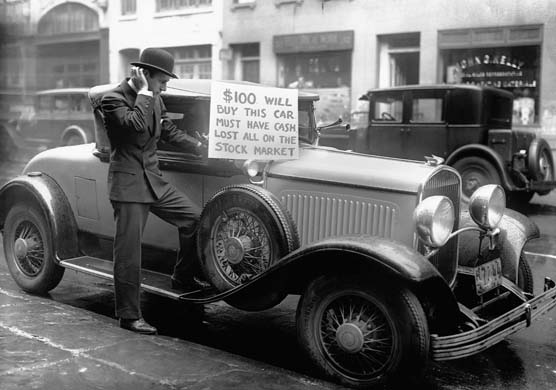
This is an image of Walter Thornton, a stockbroker who lost all of his money when the stock market crashed on Black Tuesday. This image was probably used to invoke some sense of empathy, as I'm sure Walter is selling off his auto-mobile for what I assume to be a relatively small amount of money. I chose this image due to the underwhelming amount of knowledge that I have on people who where considerably wealthy before the Depression and what happened to them afterwards, I naturally just assumed that they suffered like everyone else. However, although the man in this image appears to be in some sense of turmoil, apart from the pricing of his auto-mobile, nothing in this image really indicates that he was greatly impacted.
 Many of the wealthy in fact where not greatly impacted by the depression as only 40% of the country were hardly affected, although it could be argued that Walter was only impacted because he attempted to trade on the stock market and it fell through. I look at this image as a comment on how many people where lured into a false sense of security during the roaring twenties and despite the many 'mini' recessions that happened during that time, the American aspect of capitalism encouraged people to risk more, to want more until there was nothing left to give, ending up with people like Walter who risked all their money on the stock market, hoping that the strength of the American dollar would surely lead them to even more success and fortune. However, this was not the case and like Walter many people lost everything.


During the 'Great' recession in 2008 Lehman Brothers a global financial services firm filed for bankruptcy. before filing for bankruptcy, Lehman Brothers was the fourth  largest investment bank in the US. I chose this image due to that fact that the sign the men are carrying into Christie's, used to hold so much respect and prestige within investment banking. however, after the recession hit, the sign became a joke, a symbol of failure and collapse. The fall of Lehman Brothers Inc was seen to be a significant part of the recession and is thought to have played a major role in the unfolding of the late 2008 recession.
In comparison to the picture above from the Great Depression, it could be interpreted as a symbol of the flaws of capitalism. Two years after the recession a court case found that many executives at the bank used cosmetic accounting gimmicks at the end of each quarter in order to make its finances appear less shaky then they already were, encouraging more people to give away their money and invest it under a false sense of security. Also, in comparison to the picture above, this picture shows people willing to sell anything in order to make money, just like Walter Thornton in the picture above who is selling his auto-mobile, the two men in the picture below appear to be carrying the Lehman Brothers sign into Christie's for an auction to sell it.


Both of these images do show that regardless of public speculation, it is not only the less fortunate who suffer, on both circumstances people who would normally be considered as wealthy can be just as affected as those who are less fortunate.

Sunday, 16 November 2014

Gun Control

The Brady Campaign


The Brady Campaign

'Guns are not like drugs.. they are not smuggled into our country.... they are so easy to get hold of they are smuggled out of the US'


The Brady Campaign focuses on the issues of Guns through the use of statistics, which manage to bring home the hard hitting truth about the amount of accidental deaths of children and innocent people by guns. It also highlights the issues with trying to pass the gun control laws, by stating that the only way in which people will begin to listen and realise that guns are dangerous weapons and have no place in a home is through education.
The Brady Campaign seeks to raise funds for local communities to stop the local gun crime, this includes "bad apple" gun dealers; who supply guns without checking the background of their buyers, making it shockingly simple for any individual to buy a gun with "no tax and no paperwork".
One of the way in which the Brady campaigns aims to decrease the amount of violent gun related deaths in the US, is through the passing of policies such as keeping guns from people who can readily be identified as having bad intent, through the use of thorough Brady background checks which have managed to stop over 2 million illegal purchases of firearms and anti-trafficking policies that could play a big part in keeping guns out if the hands of local gangs.
Another way in which the Campaign aims to decrease the amount of needless deaths is through technology, using innovation in such away that prevents criminals from using stolen guns, and allowing police and dealers to effectively recognise stolen firearms.

Keep and Bear Arms

Keep and Bear Arms

'helping lawful people maintain their abilities to protect themselves and the people they love effectively from anyone who would do them harm - through legal, private ownership and use of guns. We also stand for the repealing of all gun laws which infringe on the civil rights of peaceable women and men to defend their own lives and property.'


Keep and Bear Arms is a website that says its goal it to rightly inform people about their Second Amendment rights and to correctly inform them about this right without the propaganda that other sites who may promote gun control suggest. The website starts of with the question, 'are you a red-blooded American?... with freedom running thick in your veins'. 

The websites main purpose is to teach people about their rights and it ironically does so in such way that oddly reminds me of propaganda... the formidable image of an " I WANT YOU" poster springs to mind when I read their goals of reminding the American people of the fundamental rules that the great nation of America was founded on and making them away that one of these rights the Second Amendment  is slowly being eroded away buy unconstitutional gun control laws.

In comparison to The Brady Campaign website this website isn't as professionally laid out and despite the use of strong language "born to freedom" its doesn't give much in the way of information as to what the organisations current projects are in order to spread their message; yes the do mention the fact that they aim to 'enlist' several high ranking reporters from all stated in order to bring further attention to themselves but other than that there really isn't that much of an argument. 

Which made me wonder, is it possible that The Brady Campaign's website was more professional and attractive due to the fact that gun control is only popular with a minority of people and that the use of colour and interactive videos is to attract others into their way of thinking. therefore, the Keep and Bear Arms website doesn't have to try as hard because in way, they have already "won" the argument.

Sunday, 9 November 2014

I DO NOT Pledge Allegiance


Having been asked to find a Youtube video that appropriately conveys American liberty, I initially found it quite difficult as the only videos that appeared after searching on Youtube were either songs written be Lee Greenwood, or memorial video dedicated to fallen US soldiers. This video however, was created as a part of an American liberal/progressive political and social commentary program called TYT University, the "TYT" standing for The Young Turks. In this video the video hosts discuss an incident in which a high school girl named Chelsea Stanton from New Jersey was recently reprimanded by her school for refusing to stand and recite the Pledge of Allegiance in class due to her disagreeing with the use of the word "God" in the pledge and her beliefs as an atheist.

The interesting thing about this report is mainly the views and comments made by the students that the reporters interviewed, some said that Stanton "has" and "should" stand out of respect and patriotism. However the hosts of the Youtube show agree with Stanton's stand point and argue that America was founded on people seeking religious freedom and the freedom of speech is available to all. The video host even compares the comments made by other high schools students to comments or views expressed in various media outlets in the Western world about people being "forced" to recite or do acts against their will in countries that the United States would deem as not free e.g Russia and Saudi Arabia. The way in which the video hosts stand up for Chelsea Stanton, to me, truly conveys "American Liberty" as they recognise her right to express her own individual beliefs and to not participate in anything she does not truly believe in just because everyone else around her is doing it.

Sunday, 2 November 2014

Contemporary Icons - Oprah Winfrey

 
Oprah Winfrey


One of the most famous and successful TV talk show hosts in the world and the only female black billionaire in North America, for the past 3 decades Oprah Winfrey has been able to "connect one on one with her studio and television audience by sharing her childhood story of abandonment and sexual abuse". Throughout her career however, Oprah Winfrey has received criticism from other African-Americans, for the perceived general "whiteness" of her studio and television audience, to the extent in which she has been dubbed the quintessential "mammy" because she often cries with her white audience. Although Winfrey has always identified herself as being black, many have argued that overtime due to her large success and wealth, that Winfrey is not black. Dwayne Mack's review of The Oprah Phenomenon by Jennifer Harris and Elwood Watson assesses the way in which each essay from which the book is made from touches upon the different aspects of Winfrey's life and racial identity.
 
They argue for various reasons as to why Winfrey, is still considered an icon several years after the cancellation of her popular talk show and the cancellation of the show from syndication. From the moment Oprah was born some would argue that the odds were stacked against her, a black female born into the patriarchal society of the early 1950's, the future of many African Americans at the time were very much limited. Early childhood trauma such as sexual abuse and teenage pregnancy forced Winfrey unwillingly into adulthood from a very young age. It is these experiences that Winfrey draws draws from on her TV show, so much in fact that, in popular culture the words "I was watching Oprah" is synonymous with tears and traumatic stories from various unprivileged victims.
Even now in 2014, Oprah Winfrey is name to be reckoned with "When OWN suffered a loss of nearly $143 million last year, critics proclaimed the network a failure. But Oprah Winfrey rebounded, breaking even earlier than expected". Her name alone holds so much weight in the entertainment, journalism and political industry that she is responsible for nearly a million votes on behalf of Barack Obama in 2008. 

Some would say that in a world where being female and black is the worst thing that could possibly happen to you, Winfrey has succeeded tremendously in ways that many have not, no matter which way you look at it. Especially from a feminist stand point, the fact that she has never had any biological children of her own or refuses to get married and she still proclaims to have a great sense of personal satisfaction is unheard of in a world that expects women to want these things above anything else. Therefore it does make sense that Oprah Winfrey is considered to be an icon in both African-American/Black communities and worldwide.

Monday, 27 October 2014

12 Years A Slave

Film Review


 Steve McQueen's '12 Years A Slave' is based on the incredible true story of Solomon Northup and his fight for freedom and survival in Pre-Civil War United States.  The films undeniably realistic portrayal of slavery through the eyes of a man not born a slave, but as a free man takes viewers down the tortuous path of America's shameful and inhumane past. The hauntingly beautiful Louisiana landscape is the backdrop to brutality, which in my opinion only adds to the authenticity of the movie.


The fact that McQueen an Englishman not an American sought to depict Solomon's plight in such a way that conveyed the complex emotions of regular human beings is fascinating. Many films in which slavery is conveyed, have always  dumbed down their characters to one simple idea, who is bad and who is good. in '12 Years A Slave' the boundaries between the two have been seamlessly blurred, through John Ridley's screenplay and through many of the widely unknown actors who convey the complexity of human emotion throughout the film. Cumberpatch's portrayal of the kindly Ford, Solomon's first master highlights this perfectly. Although Ford praises and encourages Solomon and even goes as far as protecting him, when Solomon tells him the truth of his kidnapping, Ford in unwilling to listen, stating only that the only thing that matters is the debt he owes. It is characters like this that authenticate this film, in real life the boundaries between right and wrong, moral and immoral are not always clearly defined, this characterisation of Ford makes his character all the more real.


The film is deeply emotional, with scenes of lynching, whipping set against scenes of community, hope and bravery. Probably the most notorious scene from the film is the scene in which Lupita N'yongo's 'Patsey' is brutally beaten and Solomon is forced to be complicit in her punishment,  remarkably over a bar of soap. However it is this scene that in my opinion although the most brutal, is the most dignified of all of Patsey's scenes. Towards the end of her beating McQueen, does something so subtle with the camera that makes me wonder if it was even intentional in the first place, he includes Patsey's hand which although are bound, they still are still clinging onto the soap, a sort of symbol of her rights, if you will a subtle fight back. Its simple and subtle scenes like these that make '12 Years A Slave' the masterpiece that it is.


In comparison to a lot of films through history that have shown the brutality of slavery '12 Years A Slave' is by far the most authentic and remarkably unbiased depiction of this. Unlike Taratino's 'Django Unchained' which is a stylised version in which the subject of a slave's revenge is explored and eventually leads to cathartic bloodbath at the end of film, which in a way provides the viewer with a sense of justice having been dealt. '12 Years A Slave' has no such "happy" ending, instead Solomon returns to his no fully grown family, which although does show some form of justice being dealt, the ending credits reveal that in fact the real Solomon Northup was never able to fully bring his captors to full justice, which in my opinion is an authentic piece of history that leaves the viewer with an overwhelming sense of emotion.

Monday, 20 October 2014

Federal Writers' Project


Clara C. Young
Mississippi Narratives, Volume XI
Page 169


Clara C. Young's account of both her childhood and adult life as both a house slave and working in the fields is very intriguing. In the narrative she states that she cannot recall the year in which she was born but knows that her surname Conley came from ‘da old marster dat owned dem’, this i found interesting  . Her and the rest of her siblings lived with their parents until the ‘ chullum drew dey parts’  and she was sold onto a new master at seventeen years old.  Clara does not say how she felt about being separated from her family and leaving the home in which she was raised. Young then goes on to describe her life at her new masters house, and how ‘Dey had a nigger woman teach all de house darkies how’ to read a’ write’ this part of Clara’s story surprised me as based on what she says contrary to popular belief there were some slaves who were given some form of education, albeit extremely basic.
 The way in which Clara explains the way in which she was 'given' to her masters son ' dey gave me to 'maree Andrew'. He car'ied me an' da rest out to Texas' implies that Clara did viewed her masters as paternal figures, the act of  being 'car'ied' and the use of such a benevolent term could imply this. She uses the term later on when she describes her new master Matthew Ewing purchasing  her and other slaves to them be 'car'ied' to his plantation in Aberdeen, Mississippi.
At the start of the interview Clara's account depicts her masters as being kind and  'thoughtful' this does continue in the rest of the interview the only person she seem to think ill of is the overseer er on the Ewing's plantation. The overseer is conveyed as being threatening and cruel as he even 'whipped wimen an' all'.
One of the most interesting parts of the interview by far, is when Clara tells the writer that her time spent with the other slaves was 'de mos fun we had'. Many of us having been raised with the idea that being slave meant you couldn't have fun, because your movement and access to things was restricted. However, Clara's depiction of her time spent with slaves from other plantations 'dey wud start sing'n and shout'n' and being joyous gatherings in which many of the slaves took comfort from the distraction of religion.
The final part of the interview is by far, from my point of view the most bizarre,as Clara's expresses her dislike for the 'Yankees'. She talks about how many of the slaves didn't know and couldn't comprehend the good freedom would bring them. She even mentions the slaves mocking the Yankees through song
'Old Mister Yankee, think he so grand,
 wid his blue coat tail, dragg'n on de ground. 
I stayed on wid Ol' marster afta' de surrender, wid de res'

Clara then goes on to say that she prefers the way her life was during slavery then what it is now with 'old age pension' saying that' If dem Yankees had lef' us lone we'd been a lot happier'. She even suggest that one of her grandchildren would have been 'de Missuses very smartes gal'. Overall, Clara C.Young's narrative of her life during slavery depicts her life as although being rough and harsh at times, she was genuinely happy being a slave, which goes against the popular belief that all of slaves during that time wanted to run away and hated their masters.

Thursday, 9 October 2014

Alaska


Alaska is a state located in the northern extremity of North America, it is the largest state by area ( over twice the size of Texas), the 4th less populous and the least densely populated out of the all the states and at least half of Alaska's 731,449 population live in the metropolitan area of Anchorage.

People tend to usually forget that Alaska is a part of the United States, mainly because it is so far removed from the rest of the States that Alaskans refer to everyone in the contiguous states as being apart of the 'Lower 48'.People from Alaska generally don't mind dissociating themselves from the rest of America, as they believe their way of life to be very different from the rest of the contiguous states. one of the differences they believe they have is the Permanent Fund Divadend, which is check a resident of Alaska receives after living there for more than a year, in essence people are literally paid to continue living in Alaska.

This doesn't mean that Alaska isn't a popular place for people to move to from other regions in the space of 14 years the amount of people who have migrated to Alaska is about 100,000, this is all due to various historical events that have taken in Alaska since the 1950's, such as the Pipeline construction in the 1970's and the Oil boom in the late 1980's. In fact more people move to Alaska from regions with warmer climates such as Florida, California and Texas than any other states in the US.

Like most of America, the most popular language is English, However, there are a range of varying languages spoken in Alaska such as Siberian, Yupik and Central Alaskan. One of Alaska's most famous features would have to be its climate, most people either American or not picture Alaska as mainly being covered in snow all year round which is generally true as as the area of Juneau is the only region in Alaska where the average daytime high temperature is above freezing.

Alaska has few road connections compared to the rest of the U.S. The state's road system covers a relatively small area of the state, linking the central population centres and the the principal route out of the state through Canada. The state capital, Juneau, is not accessible by road, only a car ferry.

Sources
http://laborstats.alaska.gov/trends/apr12art1.pdf
http://www.movoto.com/blog/opinions/alaska-stereotypes/
http://www.census.gov/hhes/migration/data/acs/state-to-state.html


Sunday, 5 October 2014

"American" Ancestry


Out of all the maps I looked at this one by far interested me the most. This is a map of the United States by county and state, identifying the largest ancestry groups in 2000.  To my surprise the largest was German and after doing some digging I found that at one time (prior to WW2) German was seriously being considered as a primary language instead of or in addition to English. The Midwest also has some smaller pockets of predominantly Norwegian, Dutch, and Finnish ancestry.  However, as was the case with many later immigrant groups from Europe, people tried to assimilate and fit in, and often times rejected their native languages in favour of English so as not to appear any more foreign than they had to, and so that they would not be considered outsiders.  Often immigrants would purposely not teach their children the language of their homeland, preferring the children to only speak English. I find the counties (mainly in the south-eastern states) identified as having “American” ancestry to be thought-provoking.  Americans did come from somewhere else, except the Native American Indians (who also came from somewhere else, but a very long time ago).  Does this mean that the self-identified “Americans” don’t know where their ancestors came from?  Or does it mean that they feel they have been in America for so long that they are entitled to say their ancestry is all “American”?  

However,  if you combine all the British groups (English, Irish, Scots, Scots-Irish, Welsh) and the people who ARE of that heritage who should have checked that off instead of “American,” British would be the largest ancestry group.  I think this is intriguing as this could mean that many Americans don’t really know where their ancestors are from or don't even care where their ancestors are from because they only identify themselves as being simply "American".

Thursday, 25 September 2014

America and Liberty


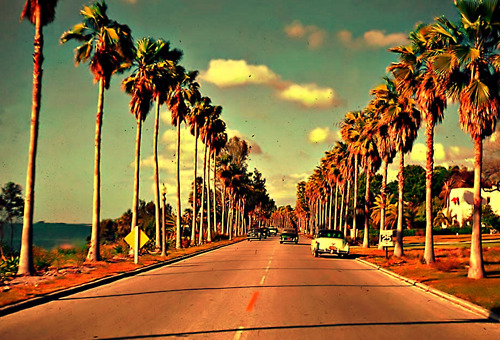
The image above affirms the association between America and liberty, as it depicts an open road underneath a blue sky surrounded by palm trees, an iconic image of Hollywood, California that symbolises prosperity. For many years, California has been conveyed as a place where anybody can reinvent themselves and seek fame and fortune. This ideal mirrors the original image of America, which was considered as a 'New World' where pilgrims could seek religious freedom, self-government and democracy.


This image however, negates the association as although an image of a native American wearing a ceremonial feathered war bonnet is an iconic one, the treatment of the native american people throughout american history is completely contradictory of the definition of liberty 'a state of being free within society without oppressive restrictions'. It could be argued that this is due to the fact that many native american traditions and customs have altogether disappeared due the native american people being gathered and placed in reservations in such a scale that by the early 19th century no 'free' native Americans remained.